
Arthritis doesn’t have to mean the end of hiking, biking, or skiing in Durango. The joint pain and stiffness that come with osteoarthritis respond well to a combination of chiropractic care and Class IV laser therapy – two drug-free approaches that address the inflammation and mobility loss driving your symptoms without the side effects of long-term medication or the risks of joint replacement surgery. Staying active in Durango’s outdoor environment is possible with the right treatment and management strategy, even with arthritis.
What’s Actually Happening in Arthritic Joints
Osteoarthritis – the most common type – involves the gradual breakdown of the cartilage that cushions the ends of bones within a joint. As cartilage thins and wears away, the joint loses its smooth gliding surface. Bone begins to contact bone more directly, the joint space narrows, and the body responds to that irritation with inflammation, swelling, and the formation of bony spurs called osteophytes.
The result is the familiar arthritis pattern: stiffness that’s worst in the morning and after periods of inactivity, pain that builds with use and eases with rest initially, and over time a progressive loss of range of motion. In the spine, arthritic changes at the facet joints and disc spaces are extremely common after middle age and are a significant driver of chronic back and neck pain in older active adults.
Arthritis can’t be reversed – the cartilage loss that has already occurred doesn’t regenerate. But the inflammation driving the pain can be reduced, the mobility loss can be slowed significantly, and the surrounding musculature can be kept strong enough to offload the arthritic joint and protect it from further wear. That’s where treatment makes a meaningful difference.
Why Durango’s Active Adults Are a Specific Case
Durango attracts and keeps active people. Retirees here are skiing Purgatory, mountain biking Hermosa Creek, and hiking into the Weminuche well into their 60s and 70s. That’s a tremendous quality of life – and it also means arthritis develops in joints that are still being asked to perform at a high level.
The challenge is managing the balance between staying active enough to maintain joint health and avoiding the overuse patterns that accelerate arthritic wear. Activity is actually beneficial for arthritic joints – movement pumps synovial fluid through the cartilage, maintains the surrounding muscle mass that protects the joint, and prevents the stiffness that worsens with inactivity. But activity without good joint mechanics, adequate recovery, and inflammation management pushes the joint further down the degenerative path.
This is the conversation Dr. Ridgway has regularly with active Durango patients in their 50s, 60s, and beyond. The goal isn’t to stop doing the things you love – it’s to do them in a way that keeps you doing them for as long as possible.
How Laser Therapy Helps Arthritic Joints
Our 30-watt Class IV K-Laser is one of the most effective tools available for managing arthritis pain and inflammation without medication. It works through photobiomodulation – delivering specific wavelengths of light energy into the joint tissue that stimulate cellular repair, reduce inflammatory mediators, and improve circulation to the affected area.
For arthritic joints, this produces several measurable effects: reduced pain and swelling, improved range of motion, and slowed progression of the degenerative changes by supporting the health of remaining cartilage and surrounding tissue. The laser penetrates deeply enough to reach hip joints, knee joints, and spinal facet joints – not just surface tissue.
Sessions involve a handheld device moved over the skin above the affected joint. Patients typically feel gentle warmth. There are no injections, no medications, and no recovery time. Most patients notice meaningful improvement in pain and stiffness within a few sessions, and the effects are cumulative with continued treatment.
Learn more about what laser therapy at our Durango clinic looks like and which conditions it addresses most effectively.
How Chiropractic Care Helps With Arthritis
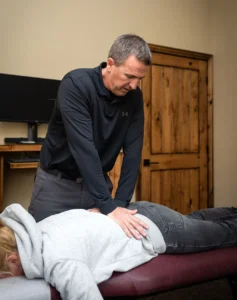
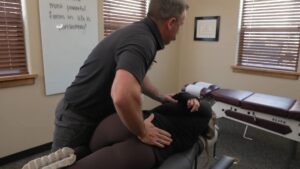
Arthritic joints lose range of motion progressively, and the joints adjacent to them compensate by moving more than they should. That compensatory hypermobility in the neighboring segments creates its own pain and accelerates their own wear. Chiropractic care addresses this pattern by maintaining as much normal mobility as possible throughout the spine and extremities – reducing the compensatory load on adjacent segments and keeping the overall mechanical environment healthier.
For spinal arthritis specifically, chiropractic adjustments to the segments above and below the most arthritic levels help preserve function and reduce the pain that comes from the cascade of compensation that develops when one area stops moving well. Instrument-assisted low-force techniques are used for arthritic joints that are too irritated for standard manipulation – the approach is always calibrated to what the joint can tolerate.
Shockwave Therapy for Arthritis-Related Tendon Problems
Arthritis frequently comes with secondary tendon problems. Arthritic knees often develop patellar tendinopathy from altered mechanics. Arthritic shoulders develop rotator cuff tendinopathy from the changed joint position. Arthritic ankles contribute to Achilles and plantar fascia issues. For these secondary tendon conditions, shockwave therapy addresses the tendon degeneration directly while laser therapy manages the underlying joint inflammation simultaneously.
Managing Arthritis in Specific Joints
Knee Arthritis
Knee osteoarthritis is one of the most common presentations we see in Durango’s active adult population. The combination of decades of trail use, skiing, and cycling takes a cumulative toll on the knee cartilage. K-Laser therapy reduces the inflammatory flare-ups that limit daily activity, while chiropractic work on the surrounding hip and ankle mechanics reduces the abnormal loading patterns that accelerate cartilage wear. Keeping the quadriceps and glutes strong is also part of any knee arthritis management plan – these muscles are the primary shock absorbers that protect the joint surface.
Hip Arthritis
Hip arthritis limits the range of motion that hiking, cycling, and skiing all depend on. Laser therapy reduces the deep joint inflammation that drives hip pain, while chiropractic adjustments to the lumbar spine and SI joint reduce the secondary back pain that almost always develops when hip mobility is restricted. Patients with hip arthritis often have significant lumbar compensation patterns that need to be addressed alongside the hip itself.
Spinal Arthritis
Facet joint arthritis in the lumbar and cervical spine is extremely common and is a significant contributor to chronic back and neck pain in older adults. The morning stiffness, the ache that builds through the day, the flare-ups after long drives or extended sitting – these are recognizable arthritis patterns that respond well to a combination of laser therapy for the inflamed facet joints and chiropractic work to maintain what spinal mobility remains. You can read more about the back pain and neck pain conditions we treat that are often connected to spinal arthritis.
What Realistic Management Looks Like
Managing arthritis well is an ongoing process rather than a fixed treatment course. Most active Durango patients with arthritis benefit from periodic maintenance care – laser therapy and chiropractic work scheduled around activity peaks and seasons – rather than treating only during acute flare-ups.
The goal is to stay ahead of the inflammation cycle. Coming in when the knee is significantly swollen and painful after a hard week of skiing takes longer to settle than managing it with regular maintenance that prevents the flare-up from developing in the first place. Dr. Ridgway will work with you on a schedule that fits your activity level and keeps you doing what you love in Durango’s outdoor environment for as long as possible.
Frequently Asked Questions
Can laser therapy actually slow arthritis progression?
The evidence suggests it can support cartilage health and reduce the inflammatory environment that accelerates degeneration – but it can’t reverse cartilage loss that has already occurred. Think of it as management rather than cure. Consistent laser therapy keeps the joint in a better state, which reduces symptoms and may slow further wear.
Is chiropractic safe for arthritic joints?
Yes, when techniques are appropriately selected. Dr. Ridgway uses instrument-assisted and low-force approaches for arthritic joints that are too irritated for standard manipulation. The assessment always comes before the treatment – no adjustment is performed without understanding what the joint can tolerate.
At what point does arthritis require surgery?
Joint replacement becomes necessary when cartilage loss is severe enough that conservative care can no longer manage pain and function adequately. That threshold is different for every patient and every joint. Many patients manage well for years with conservative care before reaching that point – and some never do. Dr. Ridgway will be honest with you about where your case falls on that spectrum.
If arthritis has been limiting your activity in Durango, schedule an evaluation at our clinic or call 970-247-5519 to talk through what a management plan would look like for you.