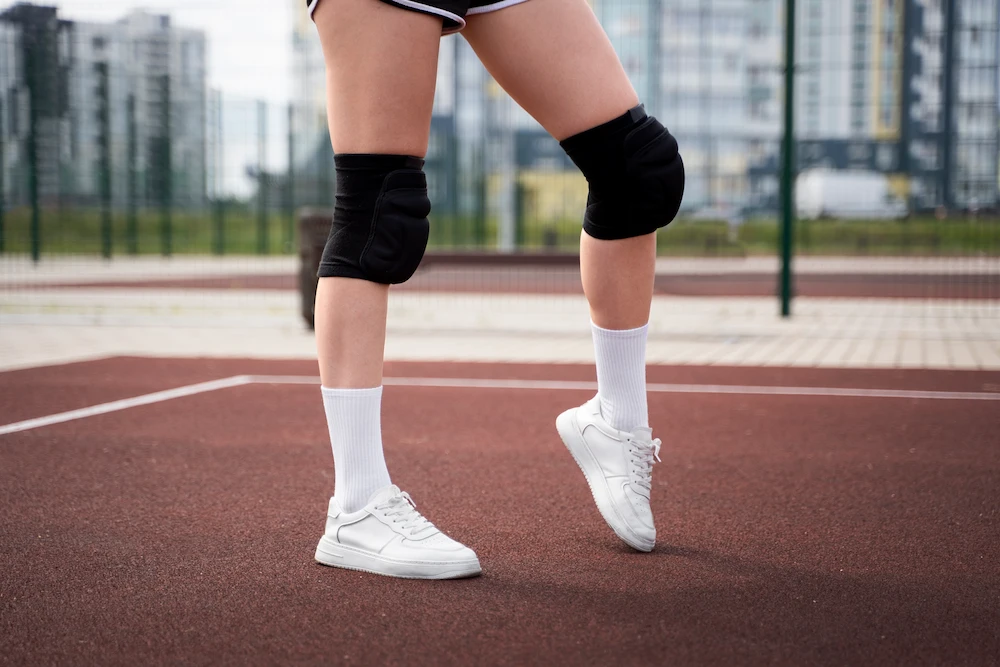
Patellar tendinopathy – commonly called jumper’s knee – is a degenerative condition of the patellar tendon that doesn’t respond reliably to rest, ice, or anti-inflammatories. Like most tendon conditions, it shifts from an acute inflammatory phase into a degenerative one quickly, and once it’s there, passive treatment stops being enough. Shockwave therapy changes the repair equation by forcing the damaged tissue into an active healing response that rest simply can’t produce on its own.
What’s Happening in the Patellar Tendon
The patellar tendon connects the bottom of the kneecap to the top of the tibia and transmits the force generated by the quadriceps during every knee extension movement – squatting, climbing, descending stairs, pedaling, hiking downhill. It’s under load constantly in active people, and when that load accumulates faster than the tendon can adapt, the collagen fibers begin to break down.
In the early stages this produces localized pain at the bottom of the kneecap that’s worst at the start of activity and eases once warmed up. As the condition progresses, pain persists through activity and eventually starts limiting what you can do. In chronic cases, the tendon develops disorganized collagen structure, reduced tensile strength, and sometimes calcification at the attachment point – none of which resolve passively.
The name “jumper’s knee” comes from its prevalence in basketball and volleyball players who do repeated explosive loading. But in Durango, we see it most in cyclists from repetitive pedaling under load, hikers from prolonged downhill descent, and skiers from the sustained quad loading of the athletic stance at Purgatory.
Why Rest Isn’t the Answer
Rest reduces the load on the tendon and brings the pain down – which is why so many patients feel better after a week off, go back to their activity, and promptly feel worse again. The underlying tendon degeneration hasn’t changed. The collagen is still disorganized, the tissue is still structurally compromised, and the first time significant load goes back through it the same symptoms return.
This cycle of rest-relief-return-recurrence is one of the clearest signs that the treatment approach needs to change. The tendon needs an active stimulus to rebuild, not just a reduction in load.
How Shockwave Therapy Treats Patellar Tendinopathy
Shockwave therapy is the primary treatment tool for patellar tendinopathy at our Durango clinic, and it works through a mechanism that passive treatment can’t replicate. The acoustic pressure waves delivered into the tendon do several things simultaneously: they break down disorganized scar tissue and any calcifications at the attachment, stimulate the production of new organized collagen, increase local blood flow to the typically low-circulation tendon tissue, and trigger a cellular repair response that restarts the healing process.
The result is tendon tissue that actually rebuilds rather than staying stuck in a degenerative cycle. Pain levels typically decrease significantly within 3-6 sessions, and tendon structure continues to improve in the weeks following treatment as the repair process progresses.
Radial Shockwave for the Tendon Body
Radial shockwave is highly effective for the patellar tendon body and the soft tissue around the knee. It delivers mechanical pressure waves across a broader surface area, addressing the tendon tissue and the surrounding structures that contribute to the overall load pattern.
Focused Shockwave for the Bone-Tendon Interface
For patellar tendinopathy with calcification at the inferior pole of the patella – where the tendon attaches – focused shockwave converges acoustic energy at a precise deep point without losing power. Dr. Ridgway frequently uses both devices in the same session for cases with attachment-point involvement, treating the tendon body with radial and the calcified attachment with focused. Having both devices available is one of the things that sets our approach apart from clinics that only offer one type. Learn more on our shockwave therapy page.
Supporting Therapies That Improve Outcomes
Shockwave is the centerpiece, but it works better alongside other treatments that address the full picture of what’s driving patellar tendinopathy.
Dry Needling for Quadriceps Trigger Points
The quadriceps – particularly the rectus femoris and vastus lateralis – almost always carry active trigger points in patients with patellar tendinopathy. These trigger points maintain elevated tension on the patellar tendon and contribute directly to the overload that drove the problem. Dry needling with microvolt e-stim releases those trigger points and reduces the resting load on the tendon between sessions. For patients with significant quad tightness, needling the muscle belly before shockwave at the tendon often produces better session outcomes.
K-Laser After Shockwave
Our 30-watt Class IV K-Laser is applied after shockwave sessions to accelerate the cellular repair process. Laser therapy works through photobiomodulation – stimulating mitochondrial activity and reducing inflammation at the tissue level. Applied after shockwave has disrupted the damaged tissue, the laser supports the repair response that follows and helps reduce post-session soreness.
Chiropractic Assessment of Knee, Hip, and Foot Mechanics
Patellar tendinopathy rarely exists in isolation from the mechanics around it. Restricted hip mobility changes how the quad loads during knee extension. Foot pronation alters tibial rotation and increases the rotational demand on the patellar tendon. Patellar tracking issues change where the tendon load concentrates. Chiropractic assessment of the full lower extremity kinetic chain identifies these contributing factors so the treatment plan addresses root causes, not just the symptomatic tendon.
Loading Rehabilitation – Getting It Right
Tendon rehabilitation research is clear that tendons need progressive loading to rebuild properly – but the sequence and timing matter enormously. Starting heavy eccentric loading before the tendon has been treated often makes things worse. The approach we use is to get the tendon into a better structural state with shockwave and soft tissue work first, then introduce progressive loading in a controlled way that rebuilds tendon capacity without re-aggravating it.
Dr. Ridgway will give you a specific loading progression based on where you are in the process – not a generic handout. For cyclists, that includes guidance on saddle height and cadence adjustments that reduce patellar tendon load during the recovery phase. For hikers and skiers, it includes specific movement modifications for descents and the ski stance that allow continued activity without stalling tendon healing.
How Long Does Recovery Take?
For patellar tendinopathy that’s been present for a few months, most patients see meaningful improvement within 4-6 shockwave sessions. Chronic cases with calcification or significant structural change take longer – typically 6-10 sessions. Progress is tracked through pain levels with activity, single-leg squat testing, and functional ability rather than just how the knee feels at rest.
In most cases you don’t need to stop your activities entirely during treatment. Activity modification during the recovery phase keeps you moving while protecting the tendon from the loading patterns that are most provocative.
Patellar tendinopathy left unaddressed long enough can progress to partial or complete tendon rupture – a significantly more serious problem that often requires surgical repair. If your knee has been nagging for more than a few weeks, getting it evaluated properly is the right call. This condition falls under the extremity pain conditions we treat regularly at our clinic.
Frequently Asked Questions
How do I know if it’s patellar tendinopathy and not something else?
The hallmark is pain at the inferior pole of the patella – the bottom tip of the kneecap – that’s provoked by loading activities like squatting, stairs, and downhill movement. Dr. Ridgway will confirm the diagnosis through orthopedic testing and differentiate it from patellofemoral pain syndrome, fat pad impingement, and other knee conditions that can present similarly.
Can I keep cycling or hiking during treatment?
Often yes, with modifications. Immediately after shockwave sessions, high-load knee activity is discouraged for 24-48 hours. Outside that window, Dr. Ridgway will give you a clear picture of what’s appropriate based on your current symptom level and how you’re responding to treatment.
I’ve had this for over a year. Is shockwave still worth trying?
Yes – shockwave can be effective even in long-standing cases, though the timeline is longer and more sessions are typically needed. The honest answer depends on the extent of structural change, which is why imaging is useful for chronic presentations. Dr. Ridgway will give you a straightforward assessment after reviewing your history and exam findings.
If knee pain has been limiting your time on Durango’s trails, bike, or slopes, schedule an evaluation at our clinic or call 970-247-5519.