Frozen shoulder – adhesive capsulitis – is one of the most frustrating conditions to go through because it follows its own timeline, tends to be resistant to standard treatment, and can sideline an otherwise active person for months. The shoulder gradually stiffens, becomes severely painful, and eventually loses so much range of motion that basic daily tasks become difficult. The good news is that shockwave therapy and laser therapy together address the underlying capsular inflammation and fibrosis more effectively than rest or cortisone injections alone – and without surgery.
What Actually Happens in Frozen Shoulder
The shoulder joint is surrounded by a flexible capsule of connective tissue that allows the wide range of motion the shoulder is known for. In adhesive capsulitis, that capsule becomes inflamed, thickens, and develops scar tissue adhesions that progressively restrict movement. The joint space shrinks. The capsule contracts. Range of motion decreases in all directions – particularly external rotation and overhead reach – and pain becomes constant rather than activity-dependent.
The condition typically progresses through three stages. The freezing stage involves increasing pain and the beginning of stiffness – this phase can last several months and is often the most painful. The frozen stage is characterized by severe stiffness with somewhat reduced pain – the shoulder is locked down but the acute inflammation has decreased. The thawing stage involves gradual, spontaneous recovery of range of motion – but this can take a year or more and often doesn’t return to full function without treatment.
What makes frozen shoulder particularly challenging is that the standard advice to “wait it out” is technically accurate – it does eventually resolve on its own for most people – but the natural timeline is 1-3 years. Most active Durango residents aren’t willing to accept 18 months of severely limited shoulder function when effective treatment can significantly shorten that timeline.
Who Gets Frozen Shoulder in Durango
Frozen shoulder most commonly develops in people between 40 and 60, with women somewhat more affected than men. It often follows a period of shoulder immobility – after a rotator cuff injury, a surgery, or even just a stretch of reduced activity. Diabetes significantly increases the risk, as does thyroid dysfunction.
In Durango’s active population, we see it develop after shoulder injuries from skiing or mountain biking crashes that were immobilized too long, after rotator cuff procedures where rehabilitation was incomplete, and occasionally without any clear precipitating event. The shoulder simply starts hurting and stiffening, and by the time patients come in it’s often already significantly restricted.
How We Treat Frozen Shoulder at Our Durango Clinic
The treatment approach depends on which stage of the condition is present. Freezing-stage frozen shoulder – where inflammation is active and pain is the dominant symptom – requires a different emphasis than frozen-stage management where stiffness is the primary problem.
Laser Therapy for Capsular Inflammation
The chronic inflammation within the joint capsule is the primary driver of frozen shoulder, particularly in the freezing stage. Our 30-watt Class IV K-Laser penetrates deeply enough to reach the shoulder capsule and delivers therapeutic energy that reduces inflammatory mediators, stimulates cellular repair, and supports tissue remodeling of the thickened capsule. Laser therapy is the most direct tool we have for addressing the capsular inflammation without injections – and unlike cortisone injections, it doesn’t carry the risk of tendon weakening with repeated use.
For patients in the painful freezing stage, laser therapy often provides meaningful pain relief within the first few sessions, which makes the other aspects of treatment more tolerable and effective.
Shockwave Therapy for Capsular Fibrosis
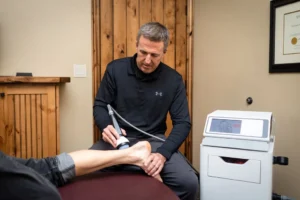
As frozen shoulder progresses, the capsule doesn’t just inflame – it develops fibrous adhesions and scar tissue that physically restrict movement. Shockwave therapy addresses that fibrosis directly. The acoustic pressure waves break down the adhesive scar tissue, stimulate the production of new organized collagen to replace the disorganized fibrous tissue, and increase local blood flow to the chronically inflamed capsule.
For frozen shoulder cases with significant capsular thickening and restricted range of motion, focused shockwave can target the capsular adhesions at depth – reaching structures that surface-level treatments can’t. Dr. Ridgway frequently combines radial and focused shockwave for shoulder cases depending on where the primary restriction is located. You can read more about the dual device approach on our shockwave therapy page.
Chiropractic Mobilization and Cervical Assessment
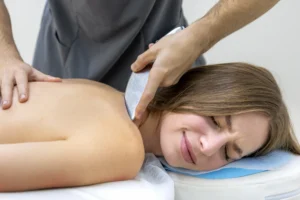
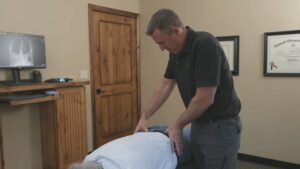
Restoring as much glenohumeral and scapulothoracic mobility as possible is critical during the frozen stage. Chiropractic mobilization of the shoulder joint uses gentle, graded movement techniques to maintain and gradually recover range of motion without provoking a pain flare. This is different from aggressive stretching or manipulation – the approach is calibrated to what the capsule can tolerate at each stage.
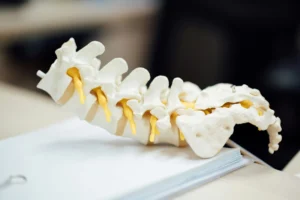
Cervical spine involvement is also worth evaluating in frozen shoulder patients. Nerve root compression at C5 or C6 can contribute to shoulder pain and weakness that complicates the clinical picture. Making sure the cervical spine is moving well and not compressing the nerves that supply the shoulder is part of a complete assessment.
Dry Needling for Secondary Muscle Guarding
The muscles surrounding a frozen shoulder develop significant trigger points and protective tension in response to the chronic pain and restricted movement. The rotator cuff muscles, upper trapezius, pectoralis minor, and subscapularis all accumulate tension that limits the recovery of range of motion even as the capsular inflammation resolves. Dry needling those trigger points reduces the secondary muscle restriction that’s layered on top of the capsular problem – which is one reason patients often regain range of motion faster when soft tissue work is part of the plan.
What About Cortisone Injections?
Cortisone injections are commonly used for frozen shoulder and can provide significant short-term pain relief, particularly in the freezing stage. They’re a reasonable option for managing acute pain – but they don’t address the capsular fibrosis that develops as the condition progresses, and repeated injections can weaken the surrounding tissue over time.
For patients who’ve had one or two cortisone injections that helped temporarily but haven’t resolved the stiffness, shockwave and laser therapy address what cortisone can’t – the structural capsular changes that are actually limiting movement.
How Long Does Recovery Take With Treatment?
With a combined shockwave, laser, and mobilization approach, most frozen shoulder patients see meaningful improvement in pain and range of motion within 6-10 sessions. Full recovery takes longer – the capsule needs time to remodel even after treatment has initiated the process – but the trajectory is significantly faster than the 1-3 year natural resolution timeline.
The earlier in the condition’s progression treatment begins, the faster the response. Freezing-stage frozen shoulder treated aggressively with laser and shockwave before significant fibrosis develops often resolves in a fraction of the time of a fully frozen shoulder that’s been present for a year.
Frozen shoulder falls under the extremity pain conditions we treat at our Durango clinic alongside rotator cuff tendinopathy, tennis elbow, and other shoulder and arm conditions.
Frequently Asked Questions
How do I know if I have frozen shoulder vs. a rotator cuff problem?
The key distinction is range of motion. Frozen shoulder restricts passive range of motion – someone else moving your arm is just as limited as your own active movement. Rotator cuff problems typically have more normal passive range with weakness or pain limiting active movement. Both can be painful, but the restriction pattern is different. Dr. Ridgway will differentiate them in the exam.
Is frozen shoulder the same on both sides?
It typically affects one shoulder at a time, but there’s a roughly 20-30% chance of developing it in the other shoulder at some point – usually within 5 years of the first episode. If the other shoulder starts developing similar symptoms, early treatment is the right call.
Can I prevent frozen shoulder from developing after a shoulder injury?
Early mobility after shoulder injuries is one of the most important preventive measures. Prolonged immobilization after a shoulder injury – whether from surgery or conservative treatment – is a significant risk factor for adhesive capsulitis. If you’ve had a shoulder injury and are noticing increasing stiffness, getting evaluated before significant restriction develops is the smart move.
If shoulder stiffness and pain have been limiting your activities in Durango, schedule an evaluation at our clinic or call 970-247-5519.