
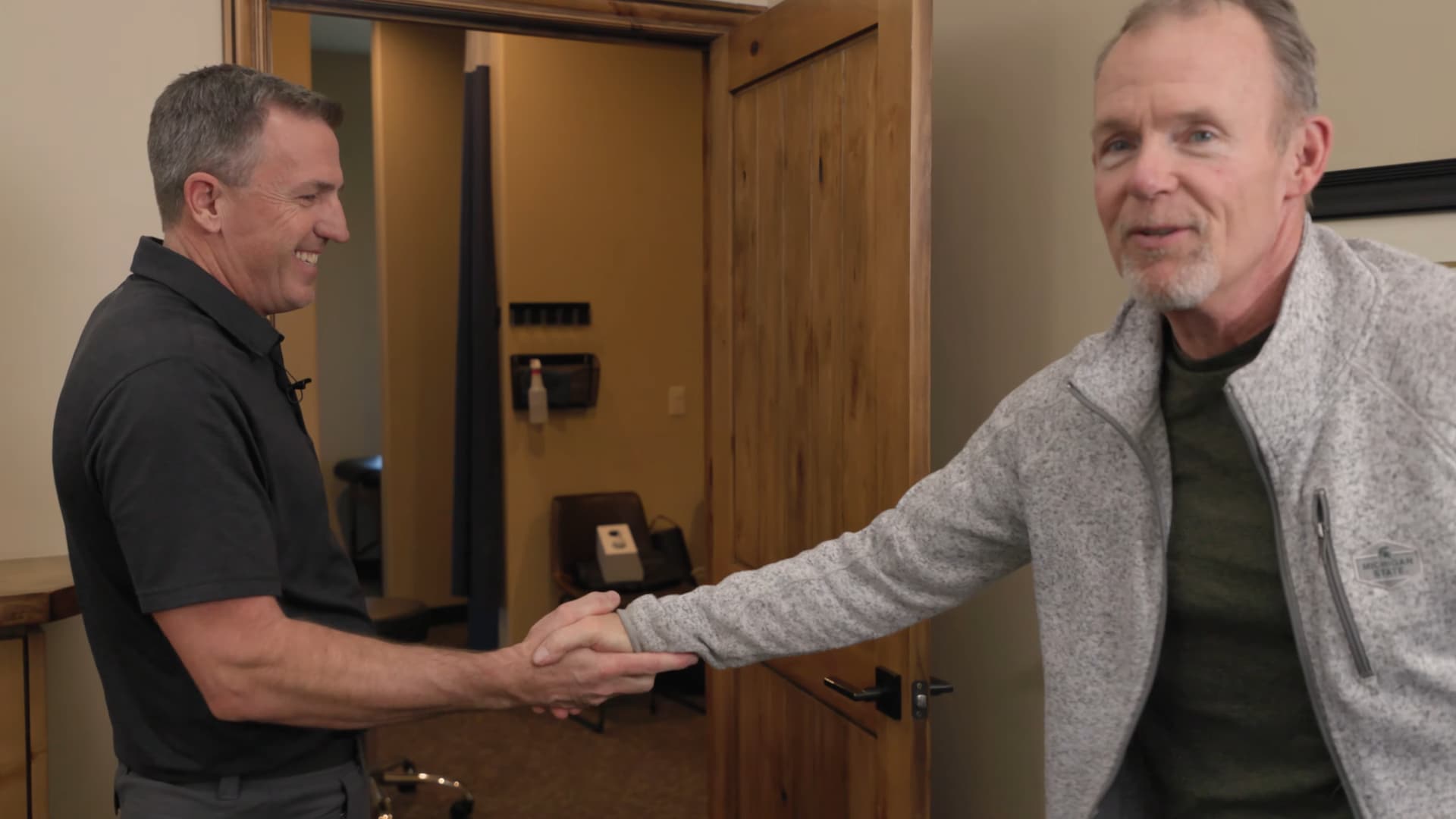
Your first visit to Durango Chiropractic Associates takes about an hour, and by the end of it you’ll have a clear picture of what’s going on and a straightforward plan for addressing it. There’s no pressure, no hard sell on a long-term package, and no vague promises. Dr. Ridgway will tell you what he finds, what he recommends, and honestly whether chiropractic care is likely to help your specific situation.
Before You Come In
If you have any relevant imaging – X-rays, MRI results, or prior diagnostic reports – bring those with you. Dr. Ridgway reviews imaging directly and uses it to personalize your treatment, especially for conditions like herniated discs or rotator cuff injuries where the imaging tells an important part of the story.
It also helps to bring a brief mental summary of your history: when the problem started, what makes it better or worse, what treatments you’ve already tried, and whether anything has helped. You don’t need a prepared statement – just be ready to have that conversation. The more context Dr. Ridgway has, the more accurate the evaluation will be.
We do accept insurance, so bring your insurance card as well. If you have questions about coverage before your visit, call us at 970-247-5519 and we’ll help you sort it out.
Step 1: The Consultation
The visit starts with a conversation – not paperwork and waiting. Dr. Ridgway will sit down with you and listen to your history. Where is the pain? When did it start? What were you doing when it began? Has it changed over time?
He’s paying attention to things that don’t always show up in imaging – movement patterns, symptom behavior, how your pain responds to different activities. For Durango patients especially, he’ll want to understand your activity level and what you’re trying to get back to. Getting you back on the trail, the slopes, or the bike is the goal, not just reducing your pain score on a 1-10 scale.
Step 2: The Physical Exam
After the consultation, Dr. Ridgway performs a thorough hands-on exam. Exactly what this involves depends on why you’re here, but it typically includes:
Postural and Spinal Assessment
Dr. Ridgway will assess your posture standing and seated, looking at spinal alignment, pelvic level, and how your head sits over your shoulders. Forward head posture, rounded shoulders, and pelvic imbalance are patterns that don’t cause pain on their own but create the conditions for chronic pain to develop. Identifying them early matters.
Range of Motion Testing
You’ll be asked to move through specific ranges – bending forward, side to side, rotating – so Dr. Ridgway can identify where motion is restricted and where it might be excessive. Pain behavior during movement is informative on its own.
Orthopedic and Neurological Tests
For spine-related complaints, he’ll run standard orthopedic tests to assess disc involvement, nerve compression, and joint integrity. If there’s any question of neurological involvement – numbness, tingling, weakness – that gets tested carefully. Straight leg raise, specific provocation tests, and reflex checks are routine for back and leg pain presentations.
Hands-On Palpation
This is where experience matters. Dr. Ridgway will feel along the spine and affected areas, identifying restricted joint segments, muscle tension, and trigger points. Patients are often surprised to find areas of significant restriction they weren’t consciously aware of – this is exactly what happened to Dr. Ridgway as a teenager when his first chiropractic exam revealed tension in his neck that was driving his chronic headaches. You can read more about his personal story on the Dr. Dustin Ridgway bio page.
Step 3: Review of Findings
Before any treatment happens, Dr. Ridgway will sit down and explain what he found. Not in medical jargon you have to nod along to – in plain terms you can actually use. He’ll show you what he observed in your posture and movement, explain what’s likely driving your symptoms, and describe what he recommends and why.
This is also where he’ll be honest if your case isn’t a good fit for chiropractic care. If he finds something that needs imaging you don’t have, he’ll tell you. If your presentation suggests a referral to another provider would serve you better, he’ll say so. The goal is for you to leave with accurate information, not just booked appointments.
Step 4: First Treatment (If Appropriate)
In most cases, the first visit includes an initial treatment. What that looks like depends entirely on what was found in the exam and what Dr. Ridgway recommends for your specific situation.
Chiropractic Adjustments
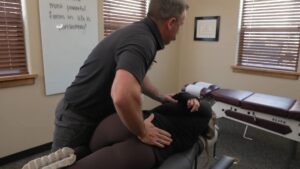
If spinal restriction is part of the picture, you’ll likely receive your first adjustment. Dr. Ridgway uses diversified technique and drop table methods for standard adjustments, or instrument-assisted techniques for sensitive areas, acute pain, or patients who prefer not to have the traditional hands-on manipulation. Both are effective – it’s about choosing the right approach for the right patient.
You can learn more about what chiropractic care at our Durango clinic looks like for different conditions.
Additional Therapies
Depending on your condition, the first visit may also include an introduction to other therapies. For disc-related cases, Dr. Ridgway may begin explaining the DRX9000 decompression protocol and set up your first session. For tendon or soft tissue conditions, shockwave therapy may be recommended and scheduled. For muscle-based pain, dry needling is often introduced early because it addresses trigger points that adjustments alone don’t reach.
Not every patient needs every service. Dr. Ridgway designs a plan based on what he actually found, not a default protocol.
Step 5: Your Care Plan
At the end of your first visit, you’ll have a clear care plan – how many visits are recommended, what therapies will be involved, and what the expected timeline looks like. Dr. Ridgway is direct about this. He won’t tell you that you need 36 visits before he knows whether 10 would do the job.
He’ll also give you practical guidance on what to do at home – specific stretches, movement drills, or activity modifications that support your recovery between visits. This matters because what you do between appointments affects how quickly you progress.
A Few Practical Notes
We run on time. Consistently. If your appointment is at 7:00 AM, you will be seen at 7:00 AM. This is something patients specifically mention in reviews, and it’s something we’re intentional about. Your time matters.
The clinic opens at 6:30 AM Monday through Thursday, which means early morning appointments before work are available. Afternoons run from 3:00 PM to 5:00 PM. Fridays, Saturdays, and Sundays we’re closed.
For more detail on what the first visit involves, visit our What to Expect page.
Frequently Asked Questions
How long will my first appointment take?
Plan for about an hour. The consultation and exam take most of that time. Follow-up visits are shorter – typically 30 to 45 minutes depending on what’s involved.
Will I get an adjustment on my first visit?
In most cases, yes – assuming the exam findings support it. There are situations where Dr. Ridgway will want additional imaging before proceeding with certain treatments, and he’ll be upfront about that if it applies to you.
I’ve tried chiropractic before and it didn’t help. Why would this be different?
That’s a fair question. The honest answer is that outcomes vary a lot depending on what’s actually driving your symptoms and whether the treatment approach matches your condition. At our clinic, we don’t apply a one-size-fits-all protocol. We also offer therapies – shockwave, decompression, dry needling, laser – that many chiropractic offices don’t have. If a prior experience didn’t get results, it’s worth understanding whether a different approach might.
If you’re ready to come in or just want to ask a question first, contact our Durango office or call 970-247-5519. We’re easy to talk to.