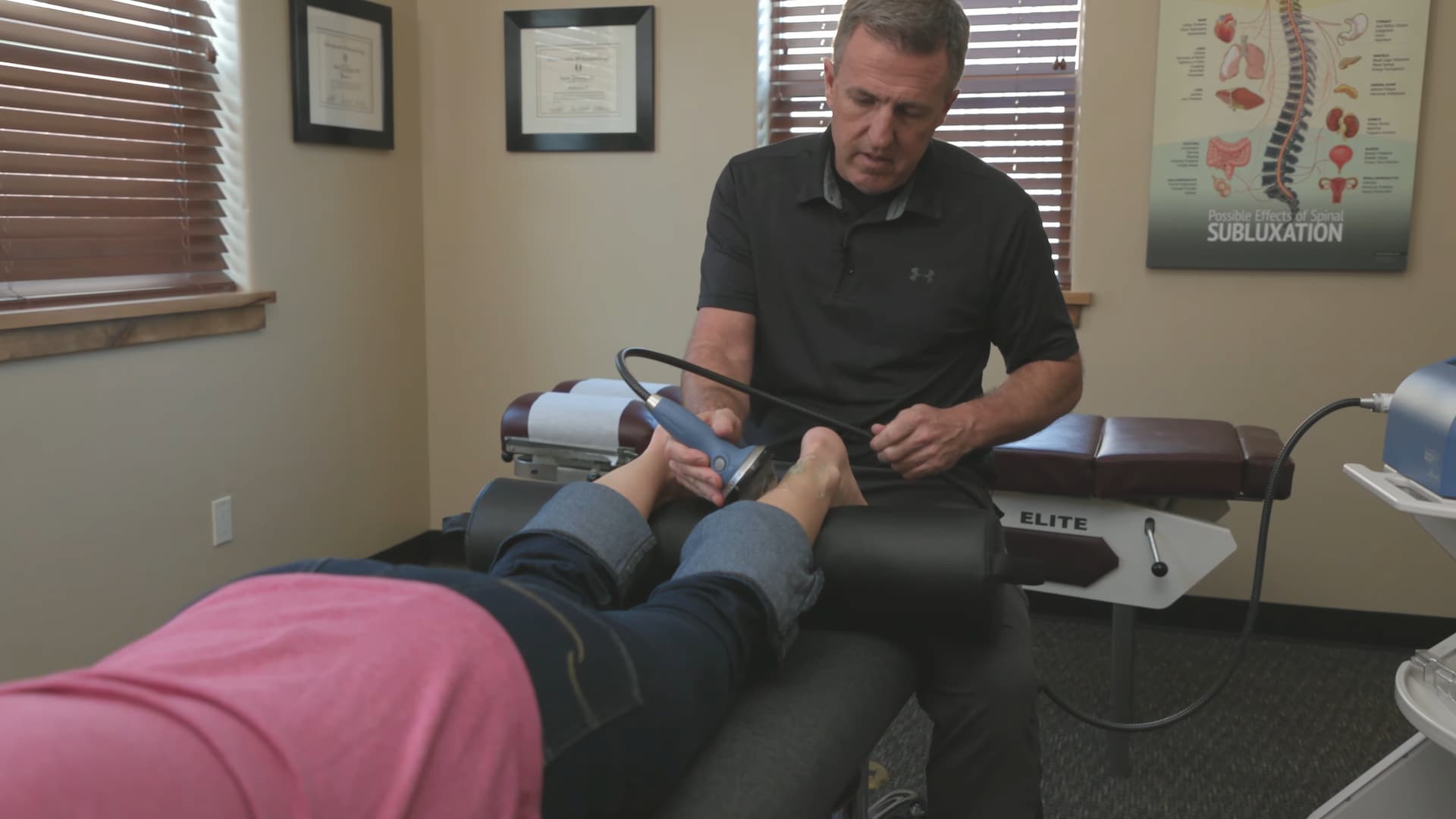
Achilles tendinopathy is one of the most stubborn overuse injuries a runner or hiker can develop, and in Durango, it’s extremely common. The tendon responds poorly to rest alone because the tissue has shifted from an acute inflammatory state into a degenerative one – and degenerated tendon doesn’t heal by sitting still. Shockwave therapy changes that equation by forcing the tissue into an active repair process that rest simply can’t trigger on its own.
Why the Achilles Tendon Is So Hard to Heal
The Achilles is the thickest, strongest tendon in the body – and paradoxically, one of the slowest to heal. The reason is blood supply. Tendons are relatively avascular compared to muscle tissue, which means they receive less oxygen and fewer of the cellular resources needed for repair. The mid-portion of the Achilles, about 2-6 centimeters above the heel, is the most vulnerable zone because it has the poorest circulation of anywhere in the tendon.
When load accumulates faster than the tendon can adapt – which happens easily in trail running, hiking steep grades, and long cycling efforts – the collagen fibers begin to break down. The body attempts to repair them, but without adequate stimulus and blood flow, the repair process is disorganized. You end up with thickened, structurally weaker tendon tissue that hurts with activity and is at higher risk for further breakdown.
This is why Achilles tendinopathy that’s been present for more than a few weeks rarely resolves with rest and stretching. The tissue needs something more targeted to restart the healing process properly.
Durango’s Terrain Makes This Worse
Flat pavement is relatively forgiving on the Achilles. Durango’s trails are not. The repeated downhill loading on Colorado Trail descents, the steep approach trails into the Weminuche, and the technical singletrack at Hermosa Creek all put the Achilles under eccentric load – the kind that accumulates damage fastest in an already compromised tendon.
Hikers deal with it too. A long day with elevation gain and loss in heavy boots puts significant cyclical stress through the Achilles, especially when the calf and posterior chain are tight from previous days of activity. We see this pattern spike in spring and early summer when Durango residents ramp their activity back up after winter.
How Shockwave Therapy Treats Achilles Tendinopathy
Shockwave therapy works by delivering acoustic pressure waves into the tendon tissue. For Achilles tendinopathy, this produces several things that passive treatment can’t: it breaks down disorganized scar tissue and calcifications, stimulates the production of new collagen, increases local blood flow to the typically avascular mid-tendon zone, and triggers a cellular repair response that restarts the healing process the tendon was stuck in.
The result is that tissue which has been degenerating and failing to repair begins to rebuild with properly organized collagen. Pain typically decreases significantly within 3-6 sessions, and tendon structure improves over the following weeks as the repair process continues.
Radial Shockwave for Soft Tissue and Tendon Body
Radial shockwave delivers mechanical pressure waves across a broader surface area, making it highly effective for the tendon body and surrounding calf musculature. For mid-portion Achilles tendinopathy – the most common presentation – radial shockwave addresses the affected tendon tissue and the tight, overloaded calf muscles that contributed to the problem.
Focused Shockwave for Insertional Cases
Insertional Achilles tendinopathy – where the pain is right at the heel rather than mid-tendon – often involves calcification at the bone-tendon interface and is a different beast. Focused shockwave converges acoustic energy at a precise deep point, which is exactly what’s needed to address calcifications and the deeper structural changes at the insertion. Dr. Ridgway frequently uses both radial and focused shockwave in the same session for insertional cases – treating the tendon body and the calcified insertion simultaneously.
Most clinics only have one type of shockwave device. Having both is a meaningful clinical advantage for Achilles cases because the mid-tendon and the insertion respond better to different devices. You can read more about how we use both on our shockwave therapy page.
Combining Shockwave With Other Therapies
Shockwave is the primary tool for Achilles tendinopathy, but it works better as part of a coordinated approach.
K-Laser After Shockwave
Our 30-watt Class IV K-Laser is applied after shockwave sessions to accelerate the cellular repair process the shockwave initiates. The laser works through photobiomodulation – stimulating mitochondrial activity and reducing inflammation at the tissue level. For an already low-blood-supply structure like the Achilles tendon, the additional healing stimulus from laser therapy makes a measurable difference in recovery speed.
Dry Needling for Calf Trigger Points
Tight, trigger-point-laden calf muscles – especially the gastrocnemius and soleus – are almost universally present in Achilles tendinopathy patients. These trigger points keep constant tension on the tendon and contribute to the overload that drove the problem in the first place. Dry needling with microvolt e-stim releases those trigger points directly, reducing the resting tension on the Achilles between sessions and making the shockwave treatment more effective.
Post-needling shockwave is a sequence Dr. Ridgway uses regularly for runners with calf and Achilles problems. The needling loosens the tissue first; the shockwave then works through a more receptive environment.
Chiropractic Adjustments for Ankle and Foot Mechanics
Restricted ankle dorsiflexion – limited upward range of motion at the ankle joint – is a consistent finding in Achilles tendinopathy patients. When the ankle can’t move through its full range, the Achilles compensates by loading at the extremes of its range with every step. Chiropractic adjustments to the ankle and subtalar joint restore that mobility and take some of the repetitive stress off the tendon during activity.
What About Eccentric Exercises?
Eccentric heel drops – slowly lowering the heel below the step – are well-established for Achilles tendinopathy rehabilitation, and they’re part of most care plans here. But for patients in significant pain, starting with eccentric loading before the tissue has been treated often makes things worse. The sequence matters: use shockwave and needling to get the tissue into a better state first, then introduce the loading exercises to rebuild tendon capacity.
Dr. Ridgway will give you a specific exercise progression based on where you are in the process, not a generic handout. The goal is to build the Achilles back to a level where it can handle Durango’s trails again without breaking down.
How Many Sessions Will It Take?
For mid-portion Achilles tendinopathy that’s been present for a few months, most patients see meaningful improvement within 4-6 shockwave sessions. Insertional cases with calcification tend to take longer – 6-8 sessions is more typical. Chronic cases that have been going on for a year or more may need additional time.
Progress is tracked through pain levels with activity, morning stiffness, and functional testing. Most patients are able to maintain some level of activity throughout treatment – you don’t need to stop running entirely in most cases. Dr. Ridgway will give you clear guidance on what load is appropriate at each stage.
Achilles problems left untreated long enough can progress to partial tears, which are significantly harder to manage without surgery. If you’ve been dealing with persistent Achilles pain in Durango, it’s worth getting it evaluated before that becomes a consideration. You can learn more about the extremity pain conditions we treat at our clinic.
Frequently Asked Questions
Can I keep running while getting shockwave treatment?
Often yes, with modifications. Immediately after a shockwave session, high-load activity is discouraged for 24-48 hours. Outside of that window, Dr. Ridgway will help you find an activity level that keeps you moving without stalling your recovery.
Is insertional Achilles tendinopathy harder to treat than mid-portion?
Generally yes, because of the calcification component and the bone-tendon interface involvement. It responds well to focused shockwave, but the timeline is typically longer and the protocol is different. Accurate diagnosis of which type you have matters before starting treatment.
I’ve had Achilles pain for over a year. Is it too late for conservative treatment?
Not necessarily. Shockwave can be effective even in long-standing cases, though the timeline is longer. The honest answer is that it depends on the extent of structural change – which is one reason imaging is useful for chronic cases. Dr. Ridgway will give you a straightforward assessment after reviewing your history and exam findings.
If Achilles pain is keeping you off Durango’s trails, schedule an evaluation at our clinic or call 970-247-5519.