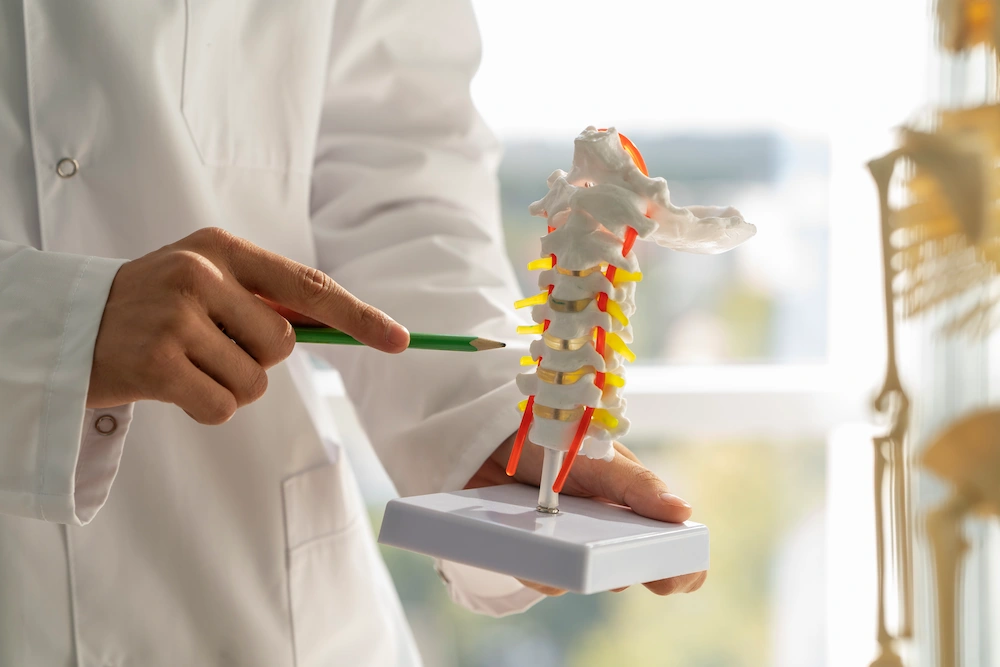
Degenerative disc disease is one of the most misunderstood diagnoses in spine care. The name sounds serious – and for many patients, hearing it for the first time feels like a verdict. But DDD isn’t a disease in the traditional sense, and it doesn’t have to mean progressive decline or inevitable surgery. Most people with this diagnosis can manage their symptoms effectively with the right non-surgical treatment approach, stay active, and avoid the operating table entirely.
What Degenerative Disc Disease Actually Is
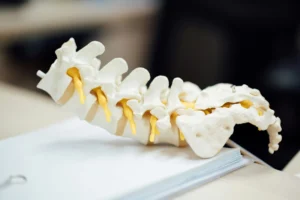
The discs between your vertebrae are made up of a tough outer ring – the annulus fibrosus – and a soft, gel-like center called the nucleus pulposus. In youth, the nucleus is well-hydrated and resilient, absorbing compressive forces effectively. With age and accumulated load, the discs gradually lose hydration and height. The annulus develops small tears. The disc space narrows. The vertebral bodies above and below begin to develop bony spurs called osteophytes in response to the changed mechanics.
This process is called degeneration, and to some degree it happens in everyone. Studies consistently show that a significant percentage of people over 40 have disc degeneration visible on MRI with no symptoms at all. The degeneration itself isn’t always the pain generator – it’s what the degeneration does to the surrounding structures that determines whether and how much someone hurts.
When degenerated discs lose enough height, the neural foramina – the openings through which nerve roots exit the spine – narrow. Nerve roots get compressed. Facet joints, which rely on normal disc height for proper mechanics, start taking abnormal load and become arthritic. The muscles around the unstable segment tighten protectively. All of that together produces the chronic, often fluctuating back and neck pain that characterizes DDD.
DDD vs. a Herniated Disc – What’s the Difference
These two diagnoses are related but distinct. A herniated disc is an acute event – disc material pushes through a tear in the annulus and compresses a nerve root, producing sharp, often radiating symptoms. It can happen in a disc that’s otherwise healthy or in one that’s already degenerated.
Degenerative disc disease is a chronic process – the gradual structural change in the disc over time that produces a different, often more persistent pain pattern. DDD pain tends to be more diffuse, more constant, and more related to sustained positions and load than the acute, often position-dependent pain of a fresh herniation.
The treatment overlaps but isn’t identical. Both conditions benefit from spinal decompression therapy, but for different primary reasons – herniation responds to decompression because it retracts the disc material; DDD responds because decompression restores disc hydration and reduces the facet joint loading that comes with disc height loss.
Why Durango’s Active Population Is Vulnerable
A lifetime of the activities Durango residents love – hiking steep grades in the San Juan Mountains, mountain biking technical trails, skiing Purgatory, carrying heavy packs into the Weminuche – is genuinely hard on the lumbar discs. The compressive and shear forces of those activities over decades accelerate the natural degeneration process. That doesn’t mean those activities caused permanent damage – it means the discs of active people often show more wear than sedentary ones of the same age.
The good news is that staying active, maintaining strong supporting musculature, and managing the mechanics around degenerated discs can keep symptoms manageable for years or indefinitely. The goal of treatment isn’t to reverse the degeneration – it’s to reduce the pain it’s causing and keep you doing the things you love in Durango.
How We Treat Degenerative Disc Disease at Our Durango Clinic
DRX9000 Spinal Decompression
The DRX9000 is one of the most valuable tools we have for DDD. The computerized traction system creates negative intradiscal pressure that draws fluid and nutrients back into the degenerated disc – partially rehydrating tissue that has been progressively drying out. Over a course of treatment, this can meaningfully reduce disc-related pain and improve the disc’s ability to handle daily load.
It also reduces the compressive load on the facet joints that have been overloaded by disc height loss. Many DDD patients whose primary pain generator is facet arthritis secondary to disc degeneration see significant improvement from decompression even when the disc itself isn’t the source of the acute pain.
Dr. Ridgway personally reviews your imaging on the first visit and designs the decompression protocol based on which levels are involved and the degree of degeneration present. The settings aren’t generic – they’re specific to your spine. Learn more about the full protocol on our spinal decompression therapy page.
Chiropractic Adjustments for Mobility and Load Distribution
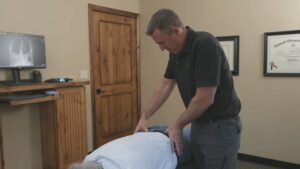
Degenerated disc segments tend to become stiff and restricted, which forces the segments above and below to compensate by moving more than they should. That hypermobility in the adjacent segments accelerates their own degeneration over time. Chiropractic adjustments maintain as much mobility as possible at the affected levels and keep the compensatory hypermobility in adjacent segments from developing into its own problem.
For DDD patients with significant facet arthritis, instrument-assisted low-force techniques are used rather than standard manipulation – the approach is always calibrated to what the affected segments can comfortably tolerate.
Laser Therapy for Inflammation and Nerve Pain
Chronic inflammation around degenerated disc segments and arthritic facet joints is a major driver of DDD pain. Our 30-watt Class IV K-Laser reduces that inflammation at the cellular level and supports nerve tissue health when nerve root irritation is part of the picture. Laser therapy is particularly useful for DDD patients whose symptoms fluctuate with activity and weather – managing the inflammatory component keeps the baseline pain level lower between flare-ups.
Dry Needling for Paraspinal Muscle Guarding
The muscles surrounding degenerated disc segments develop chronic protective tension and trigger points that often contribute as much to daily pain as the disc itself. Dry needling releases those trigger points directly and reduces the resting muscle tension that compresses an already narrowed disc space further. For DDD patients, keeping the paraspinal muscles from going into chronic guarding is one of the most practical things treatment can accomplish for day-to-day pain management.
What Long-Term Management Looks Like
DDD is a chronic condition, which means management rather than cure is the realistic framing. Most patients benefit from periodic maintenance care – decompression sessions, adjustments, and laser therapy scheduled around activity peaks and symptom flare-ups – rather than treating only when pain becomes severe.
Staying active matters too. Movement keeps the discs as hydrated as possible, maintains the muscle mass that protects the spine, and prevents the stiffness that worsens with inactivity. Dr. Ridgway will work with you on an activity and maintenance plan that fits your lifestyle in Durango – not a generic recommendation to avoid everything that loads the spine.
You can read more about the related conditions we treat on our herniated and bulging disc page and our back pain page.
Frequently Asked Questions
Does degenerative disc disease always get worse over time?
Not necessarily. Degeneration is a natural aging process, but its rate varies significantly between individuals and is influenced by activity level, mechanics, and how well the supporting musculature is maintained. Many people with DDD on imaging have stable symptoms for years or decades with appropriate management.
Will I eventually need surgery for DDD?
Many patients with DDD never need surgery. Surgical intervention becomes relevant when conservative care can no longer manage pain and function adequately – which is a threshold that varies by individual. Dr. Ridgway will be honest with you about where your case falls on that spectrum and when a surgical consult makes sense.
Can I keep hiking and biking with degenerative disc disease?
In most cases, yes – with appropriate load management and maintenance care. Staying active is generally beneficial for DDD. The goal is to keep you doing the activities you love in Durango while managing the mechanical environment around the affected discs as well as possible.
If you’ve been diagnosed with degenerative disc disease in Durango and want to understand your options, schedule an evaluation at our clinic or call 970-247-5519 to talk through what a management plan would look like for you.