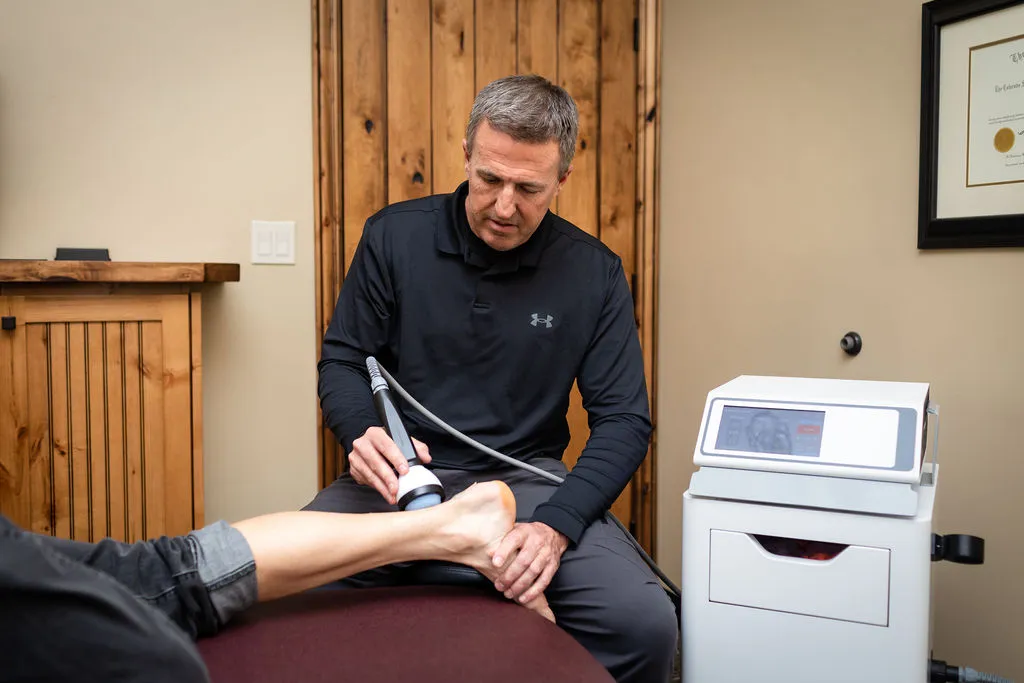
Plantar fasciitis is one of the most stubborn conditions we treat at our Durango clinic, and it’s also one of the most misunderstood. Rest, stretching, and supportive shoes can take the edge off the pain, but they don’t address the underlying tissue damage that’s keeping the heel from fully healing. Shockwave therapy gets to that root cause – and for most patients dealing with chronic plantar fasciitis, it’s the treatment that finally turns the corner.
Why Plantar Fasciitis Lingers
The plantar fascia is a thick band of connective tissue running along the bottom of your foot, connecting your heel bone to your toes. When it’s repeatedly stressed – through running, hiking, long days on your feet, or simply tight calves pulling on it from above – small tears develop in the tissue.
Here’s the problem: the plantar fascia has relatively poor blood supply. That means the micro-tears don’t get the nutrients and cellular activity needed to repair properly. Over time, the tissue becomes what’s called a chronic tendinopathy – a degenerative condition rather than an active inflammation. That’s why anti-inflammatories and rest help temporarily but don’t solve it. You’re not dealing with ongoing inflammation anymore. You’re dealing with tissue that has stopped healing.
In Durango, where trail runners, hikers, and cyclists put serious miles on their feet year-round, we see this pattern constantly. Patients come in having already tried months of stretching and orthotics with only partial results.
What Shockwave Therapy Does Differently
Shockwave therapy works by delivering acoustic pressure waves into the affected tissue. Those waves do a few things that rest and stretching simply can’t.
First, they break down calcifications and scar tissue that have built up in the chronically injured area. Second, they stimulate what’s called neovascularization – the formation of new blood vessels in tissue that had become poorly vascularized. Better blood flow means better healing. Third, they trigger a controlled inflammatory response that essentially restarts the body’s repair process in tissue that had stalled out.
The result is that shockwave therapy doesn’t just manage plantar fasciitis symptoms – it gives the tissue what it needs to actually heal.
Radial vs. Focused Shockwave for Plantar Fasciitis
Most clinics that offer shockwave therapy have one device – either radial or focused. At our Durango clinic, we have both, and that makes a meaningful difference for plantar fasciitis specifically.
Radial shockwave delivers pressure waves across a broader surface area. It’s highly effective for the plantar fascia itself and the surrounding soft tissue close to the skin’s surface. Most of the heel pain and fascia thickening responds well to radial treatment.
Focused shockwave converges acoustic energy at a precise point deep in the tissue – up to 12 centimeters below the surface without losing power. This is what we use to target the bone-tendon interface at the heel, where calcifications often form and where the deepest tissue damage tends to occur.
For a lot of plantar fasciitis cases, using both in the same session gives better outcomes than either device alone. We’re treating the surface tissue and the deep root cause at the same time.
What to Expect with Shockwave Treatment
Most patients with chronic plantar fasciitis start noticing meaningful improvement within 3-6 sessions. Each session takes about 10-15 minutes for the shockwave portion, and there’s no downtime – most patients walk out and go about their day.
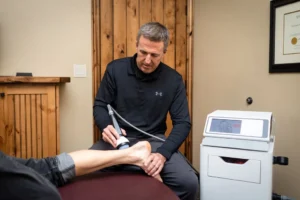
The treatment itself involves a handheld device applied directly to the heel and arch. Some patients feel mild discomfort during the session, particularly over the most tender areas. That discomfort is a sign we’re in the right spot. Post-session soreness is normal and typically resolves within 24-48 hours.
We often combine shockwave with K-Laser therapy applied after the shockwave session. The laser supports the repair process by reducing inflammation and stimulating cellular healing in the tissue we just treated. It’s a combination that consistently produces better results than shockwave alone.
When Shockwave Is the Right Call
Shockwave therapy is most effective for plantar fasciitis that has been present for at least 3-6 months and hasn’t fully resolved with conservative care. If you’ve already done the stretching routine, tried orthotics, and rested it – and the heel pain is still there first thing in the morning or after time on your feet – that’s a good indication the tissue needs a more direct intervention.
It’s also a strong option if imaging has shown calcification at the heel attachment point. Focused shockwave is particularly good at breaking down those calcium deposits without surgery or injections.
Shockwave isn’t always the first step for every foot pain presentation. If the issue is more acute or there are other structural factors involved, we’d work through those first. But for chronic, stubborn plantar fasciitis, it’s one of the most effective non-surgical tools available.
Addressing the Full Picture
Plantar fasciitis rarely exists in isolation. Tight calves, limited ankle mobility, and altered gait mechanics all contribute to the load placed on the plantar fascia. Treating the heel without addressing those upstream factors means the problem is likely to return.
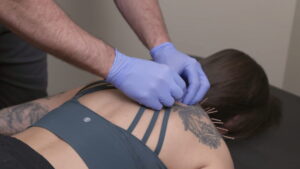
As part of a complete treatment plan, we also look at calf and Achilles flexibility, hip mechanics, and whether there’s any referred nerve component contributing to the foot and heel pain. Sometimes dry needling into the calf and soleus muscles takes significant tension off the plantar fascia and speeds up recovery considerably.
The goal is to get you back on Durango’s trails – not just to get the pain down enough to limp through your day.
How Long Until You Can Get Back to Running or Hiking?
That depends on how long the condition has been present and how the tissue responds to treatment. Most patients with chronic plantar fasciitis see significant improvement within 4-8 weeks of starting shockwave therapy. Some return to full activity sooner. We track progress using specific measurements at each visit so you always know where you stand.
We won’t push you back into full activity before the tissue is ready – that’s how re-injury happens. But we also won’t keep you sidelined longer than necessary. Durango’s trail season waits for no one.
If heel pain has been slowing you down, call us at 970-247-5519 or schedule a visit online to find out if shockwave therapy is the right next step for you.