
Cracking your own back or neck occasionally isn’t dangerous, but if you find yourself doing it constantly to get relief, that’s a sign something isn’t right – and the self-cracking is probably making it worse, not better. The pop you create when you twist your own spine isn’t the same as a chiropractic adjustment, and the difference explains why self-cracking gives you a few minutes of relief but never actually solves the problem.
What Actually Happens When a Joint Cracks
The popping sound itself is harmless. It comes from the spinal facet joints, which are surrounded by a capsule filled with fluid. When the joint is stretched and the capsule expands quickly, dissolved gases in the fluid form a bubble that collapses, producing the audible pop. This is called cavitation, and it’s the same mechanism whether you crack your own knuckles, twist your own back, or get adjusted by a chiropractor.
So the sound isn’t the issue. The persistent myth that cracking your knuckles or back causes arthritis has been studied repeatedly and doesn’t hold up. The concern with habitual self-cracking is different and more subtle.
Why Self-Cracking Doesn’t Fix the Problem
Here’s the key distinction. When you crack your own back, you twist your whole spine until something pops – and what pops is whichever joint is already the most mobile, because that’s the one that moves most easily. The joint that’s actually restricted, the one causing your discomfort, doesn’t move. It’s too stiff. So you end up repeatedly cavitating the joints that are already moving well while the genuinely restricted segment stays stuck.
That’s why self-cracking feels good for a few minutes and then the tightness comes right back. You’re getting a brief release of tension and a rush of endorphins from the pop, but you’re not addressing the restricted joint that’s driving the problem. Within a short time the tension returns, you crack again, and the cycle repeats – sometimes dozens of times a day.
Over time, repeatedly mobilizing the already-mobile joints can make them even looser, while the restricted joint stays restricted. That growing imbalance – hypermobile segments next to stuck ones – is its own source of pain and dysfunction.
How a Chiropractic Adjustment Is Different
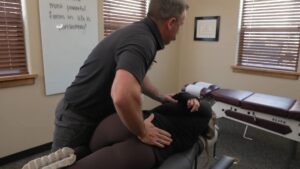
A chiropractic adjustment isn’t just “cracking the back” with more force. The fundamental difference is specificity. Dr. Ridgway first identifies which specific joint segment is restricted through examination – assessing movement, palpating the spine, and locating where mobility is actually limited. The adjustment is then directed precisely at that restricted segment, using a controlled, targeted force at the right angle and depth to restore movement to that specific joint.
This is the opposite of self-cracking. Instead of twisting everything until the loosest joint pops, the adjustment targets the stuck joint that self-cracking never reaches. That’s why an adjustment produces lasting relief while self-cracking produces a few minutes of it – the adjustment actually addresses the restricted segment that’s causing the problem.
Chiropractic adjustments also use a range of techniques calibrated to the patient and the joint. Diversified technique, drop table methods, and instrument-assisted low-force approaches all exist precisely because different joints and different patients need different approaches – something self-cracking can’t offer.
When Constant Self-Cracking Is a Warning Sign
The urge to constantly crack your neck or back is your body telling you that a joint is restricted and the surrounding muscles are tightening to protect it. The constant tension you’re trying to relieve is the symptom. The restricted joint is the cause.
If you’re cracking your neck or back many times a day to get relief, that pattern usually points to a genuine joint restriction that isn’t being resolved. People with chronic neck pain are especially prone to compulsive self-cracking, because the cervical spine is easy to manipulate and the brief relief is reinforcing. But the more you do it, the more you may be destabilizing the healthy joints while the actual problem persists.
Is Self-Cracking Ever Actually Dangerous?
For most people, occasional self-cracking of the back is low-risk. The neck is where more caution is warranted. Aggressive, forceful self-manipulation of the neck – particularly rotational cranking – carries a small but real risk because of the important blood vessels and neural structures in that region. Forceful neck self-cracking is worth avoiding.
The bigger issue for most people isn’t acute danger – it’s that habitual self-cracking is a sign of an unresolved problem and may gradually worsen the underlying joint imbalance. If you feel like you need to do it constantly, that’s worth getting evaluated rather than continuing to manage with self-manipulation.
What to Do Instead
If you’re a chronic self-cracker, the goal is to address the restricted joint that’s driving the urge. A proper evaluation identifies which segment is actually stuck, and a targeted adjustment restores its movement. Once the restricted joint is moving normally, the constant tension that makes you want to crack typically resolves – and the compulsive cracking habit fades with it because the underlying driver is gone.
Gentle mobility work and stretching can help in the meantime, but they address the symptom rather than the restricted joint. For lasting relief, the restricted segment needs to be specifically identified and treated.
Frequently Asked Questions
Does cracking my back cause arthritis?
No. This is a persistent myth that’s been studied and doesn’t hold up. The cavitation sound itself doesn’t damage the joint or cause arthritis. The concern with habitual self-cracking is the underlying joint imbalance it can reinforce, not arthritis.
Why does my back feel tight again so quickly after I crack it?
Because self-cracking mobilizes the joints that are already moving well, not the restricted joint causing the tension. The brief relief fades quickly because the actual problem – the stuck segment – wasn’t addressed. That’s the cycle that keeps you cracking repeatedly.
Is it bad that I crack my neck a lot?
Frequent neck self-cracking is worth paying attention to. Beyond the small risk of forceful rotational self-manipulation, the constant urge usually signals a restricted joint that isn’t being resolved. Getting it evaluated addresses the root cause rather than managing it with repeated cracking.
If you find yourself constantly cracking your back or neck for relief, schedule an evaluation at our Durango clinic or call 970-247-5519 to find out what’s actually restricted.