Pain that moves around – in your lower back one week, your hip the next, then your knee – usually isn’t several separate problems. More often it’s one underlying issue showing up in different places as your body compensates, or it’s referred pain traveling along a nerve from a single source. Understanding why pain shifts helps explain why chasing each new symptom separately rarely works, and why finding the original driver is what actually resolves it.
Pain That Moves Is Usually Telling You Something
When pain stays in one spot, it’s relatively easy to think about – something at that location is the problem. When it moves around, it’s more confusing and often more frustrating, because just as you start addressing one area, the pain seems to relocate. People sometimes worry that moving pain means something is seriously wrong or that they have multiple unrelated problems piling up.
In most cases, the explanation is more straightforward, and it usually comes down to one of three patterns: referred pain from a single source, compensation as one area protects another, or a movement dysfunction that loads different structures at different times.
Referred Pain: One Source, Multiple Locations
Referred pain is when the source of the problem is in one place but you feel the pain somewhere else. It happens because nerves serving different areas of the body share pathways, and the brain can’t always pinpoint exactly where a signal originated.
A classic example is the lumbar spine. A problem at a single disc level in the lower back can refer pain into the buttock, the hip, down the leg, and sometimes all the way to the foot – following the path of the affected nerve. To the person experiencing it, the pain might seem to migrate between the back, hip, and leg on different days depending on activity and position. But it’s all coming from one source in the spine.
The same happens elsewhere. Trigger points in a single muscle can refer pain to predictable but distant locations – a trigger point in the gluteal muscles can send pain down the leg, while one in the neck can refer pain into the head and shoulder. Dry needling is particularly effective for referred pain from trigger points because it addresses the actual source muscle rather than the locations where the pain is felt.
Compensation: One Problem Creating Others
The second common reason pain moves is compensation. When one part of your body isn’t working well, the surrounding structures change how they move to protect it or work around it. Those compensating structures then take on load they’re not designed for, and eventually they start hurting too.
Here’s how it often plays out. A restricted hip changes how you walk, which loads the lower back differently, which eventually irritates the back. You address the back, but because the hip restriction is still there, the compensation continues and the pain shows up next in the knee, which is now absorbing the altered mechanics. Each new area of pain is real, but they’re all downstream of the original hip restriction.
This is why treating each painful area in isolation often feels like whack-a-mole. You quiet one spot and another flares up, because the root cause – the original dysfunction driving all the compensation – hasn’t been addressed. Identifying and treating that original driver is what stops the pain from relocating.
Movement Dysfunction: Different Loads, Different Days
The third pattern relates to how movement patterns load different structures depending on what you’re doing. If you have an underlying imbalance – weak glutes, poor core stability, restricted spinal mobility – different activities stress different structures, so the pain appears to move based on your activity rather than staying fixed.
A run might provoke the knee one day because of how the imbalance loads it; a long drive might provoke the back the next because sitting loads a different structure. The underlying problem is the same movement dysfunction, but it expresses itself in whichever structure that day’s activity stresses most. For active Durango patients who do a variety of activities – hiking, biking, skiing – this pattern is common, because each sport loads the body differently.
Why Chasing Each Symptom Separately Doesn’t Work
The common thread across all three patterns is that the pain you feel and the source of the problem are often in different places. Treating only where it hurts – the location of the symptom – leaves the actual driver in place. That’s why pain that moves around responds poorly to symptom-chasing and responds well to an approach that looks for the underlying source.
An accurate assessment looks at the whole picture rather than just the area that hurts today. Where is movement restricted? Where is there weakness or instability? Does the pain pattern match a known referral pathway? Is there a compensation chain that connects the different areas of pain? Answering those questions is how you find the one thing driving the several symptoms.
How We Approach Moving Pain at Our Durango Clinic
Dr. Ridgway’s evaluation is built around finding the source rather than just the symptom. That means assessing movement throughout the relevant region, identifying restrictions and compensation patterns, recognizing referral patterns, and connecting the dots between the different areas where you’re feeling pain.
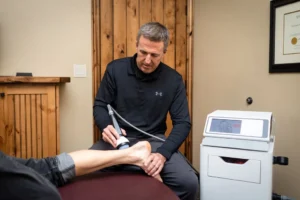
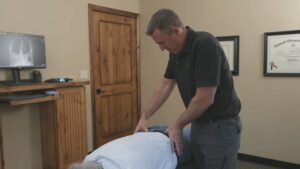
From there, treatment targets the actual driver. Chiropractic adjustments restore mobility to the restricted joints fueling compensation. Dry needling addresses trigger points generating referred pain. And the movement dysfunction underlying the whole pattern gets addressed through specific corrective work, so the compensation doesn’t just start up again.
For pain that connects to the spine – which a great deal of moving pain does – addressing the spinal source often resolves symptoms in several downstream locations at once. You can read more about how we approach back pain and the way spinal issues refer pain elsewhere.
When Moving Pain Warrants Prompt Evaluation
Most moving pain is mechanical and follows the patterns described above. But certain features warrant prompt medical attention rather than routine care: pain accompanied by progressive weakness, numbness in the groin area, loss of bladder or bowel control, fever, or unexplained weight loss. These are uncommon but important to take seriously. For typical mechanical moving pain, a thorough evaluation to find the source is the right next step.
Frequently Asked Questions
Does moving pain mean I have multiple problems?
Usually not. More often it’s a single underlying source showing up in different places through referred pain or compensation. Identifying that one driver typically resolves the symptoms across the different locations.
Why does my pain change with different activities?
Because different activities load different structures. If there’s an underlying movement imbalance, whichever structure that day’s activity stresses most is where you feel it. The root cause is consistent even though the pain location shifts.
Why does treating the spot that hurts not help?
Because the source of the pain and the location you feel it are often different. Treating only the painful spot leaves the actual driver – a restricted joint, a trigger point, or a movement dysfunction elsewhere – in place, so the pain persists or relocates.
If your pain keeps moving around and you want to find what’s actually driving it, schedule an evaluation at our Durango clinic or call 970-247-5519.